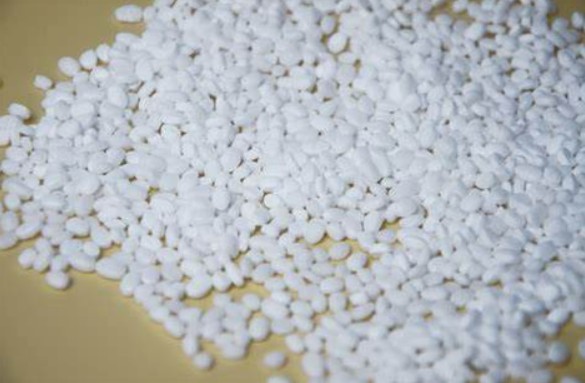
I. EPP (Expanded Polypropylene) is a high-foamed polypropylene.
It is a polymer/gas composite material with excellent performance and high crystallinity. Due to its unique and superior properties, it has become the fastest-growing environmentally friendly new pressure-resistant cushioning and thermal insulation material.
EPP products have excellent shock-absorbing performance, high recovery rate after deformation, good heat resistance, chemical resistance, oil resistance, and thermal insulation. In addition, they are lightweight, which can significantly reduce the weight of items. EPP is also an environmentally friendly material that can not only be recycled but also naturally degraded without causing white pollution.
II. How is EPP foamed and manufactured?
The manufacturing principle of EPP is actually a well-known "popcorn" principle:
1.After closing the mold, granular raw materials are blown into the mold at high speed from the feed inlet. It is necessary to ensure the air outlet is unobstructed and the air output is greater than the air input to fill the raw materials into all parts.
2.Seal the mold, apply high temperature and pressure (3-5 atmospheres) to allow air to enter the interior of the granular raw materials. Then, suddenly release the seal, and the granular raw materials expand rapidly under high pressure to form the shape. This is how "popcorn" is made.
3.After foaming and molding, heating is required again to melt the surface of each foamed particle, followed by cooling, so that all particles are bonded together into one piece.
4.Then, cold water is sprayed onto the mold and the material from points "A" and "B" to cool it down, while causing the material to shrink for easy demolding.
5.After removing the material, it is placed in an oven to evaporate the moisture, and at the same time, the material that has shrunk due to cold water gradually expands to the required size.
6.After several fluctuations of contraction, expansion, re-contraction, and re-expansion, the material's dimensions and other data meet the required range.
Precisely because of EPP's complex manufacturing process, its processing equipment and molds are very expensive, making the cost of EPP products far higher than that of ordinary foamed products. However, given EPP's superior performance, this is acceptable.
I. Principle of the foaming molding machine
1.Types of foaming raw materials: EPS, EPP, EPE, EPO, etc.
2.Molding principle: mold closing, material feeding, steam heating for molding, cooling, and demolding.
II. Overall structure of EPS molds
Molds are designed according to the types of customer machines to match the customer's equipment.
1.Water tank (steam chamber): Three-plate molds, with standard water tanks for customers. Machines like Taiwanese machines and Bach machines do not have standard water tanks, so the water tank must be determined according to the product's mold arrangement, also called integrated molds.
2.Three-plate molds consist of three plates: the male mold plate, female mold plate, and gun plate. The male mold plate fixes and connects the male mold cavity, the female mold plate fixes and connects the female mold cavity, and the gun plate (also called the rear sealing plate or back plate) mainly installs ejector rod sleeves and material guns.
3.Material pressing: A structure designed for the cooperation of the male and female molds to facilitate pre-opening and feeding during molding, preventing material leakage during pre-opening. Calculated based on the water tank's mold-closing steps and template, there are two types of material pressing: with and without clearance. For no clearance, the material pressing of the male and female molds is the same; for clearance, the female mold's material pressing plus the clearance equals the male mold's material pressing, and the female mold's material pressing should be no less than 10 mm.
4.Flange edge: The space between the female mold and the female mold plate, facilitating screw installation. It is generally about 15 mm, not less than 10 mm, determined by the water tank's mold-closing steps and template. There is also an inverted support type, where the height is determined by the template's thickness (e.g., Kurt machines typically use inverted support, while Japanese machines generally use front installation with flange edges).
5.Wall thickness: The wall thickness of EPP molds is generally about 15 mm; EPS and EPO molds are 8-10 mm; EPE molds are generally 15 mm, unless otherwise specified by customers.
6.Shrinkage: General foaming molds have a shrinkage rate of 0.3% for EPS materials (0.4% abroad), and low magnification customers may require 0.25%, 0.2%, etc. EPO materials generally have a shrinkage rate of 0.9%-1.0%. EPP and EPE materials have different shrinkage rates depending on the magnification, and they also vary by raw material types (e.g., JSP and Kaneka raw materials). Therefore, the shrinkage rate for EPP and EPE materials is provided by customers or raw material manufacturers (e.g., domestic companies JSP and Kaneka).
7.Air cores: Sizes include ∮4, ∮6, ∮8, ∮10, ∮12, etc., in strip and pinhole types, as well as non-porous air cores. They are classified as general or special air cores (e.g., strip-type straight slots of 0.25-0.4 mm are special, usually processed by wire cutting; ordinary strip-type straight slots are 0.8-0.7 mm). EPS raw material molds often use pinhole air cores, while EPP and EPE molds more commonly use strip air cores (pinholes are generally used for planes and sides). By material, air cores can be aluminum, copper, or stainless steel, with aluminum being the most common, and others determined by customer requirements.
8.Installing air cores: First, drill holes (usually 0.3-0.4 mm smaller than the air core diameter), distribute air cores evenly (EPS typically uses a 25×25 mm spacing, EPP and EPE use 20×20 mm spacing unless otherwise specified). Air cores must be tapped flat in three stages (tapping flat in one step may cause looseness), with no crescent shapes around them. Polish the air cores and tool marks to make the mold surface smooth and bright, and add ∮0.6-0.8 mm pinholes in dead corners.


400-998-7670
0769-81780010
billshi@easybach.cn
liyang@easybach.cn
jinhe@easybach.cn
+8618128572238 ( International Sales & Trade)
+8615707078588 (Global Sales)
Bach_Sale
EasyBach_Global
 Home
Home